Guide
How to make a wedding seating chart, step by step
What you need before you start
- A guest list with RSVPs. You can start a draft without every reply, but not without most of them.
- The floor plan. Ask your venue for the room layout, table sizes and the maximum per table, and where the dance floor, bar, DJ, exits and restrooms are.
- Your table count. 60-inch rounds seat 8 comfortably and 72-inch rounds seat 10. The table calculator works it out for your guest count.
- Meal choices and dietary needs, if you're serving a plated dinner.
Step 1: Wait until most RSVPs are back
A chart built on guesses gets rebuilt. Most couples set the RSVP deadline three to four weeks before the wedding and start the real chart when around three quarters of the replies are in. A rough draft earlier is still useful for deciding how many tables to rent. See the seating chart timeline.
Step 2: Map the room
Sketch the room with the fixed pieces first: the dance floor, bar, DJ or band, cake table, buffet and doors. Then place your tables. Number them in an order guests can follow, for example Table 1 nearest the couple and the rest working outward, so nobody has to hunt for Table 14.
Step 3: Choose a head table or a sweetheart table
A head table seats you with your wedding party; a sweetheart table seats just the two of you, and the wedding party sits with their partners. Your choice decides where about ten people sit, so make it early. Compare both in head table vs. sweetheart table.
Step 4: Sort guests into groups
Before you think about tables, sort everyone into groups: each partner's family, college friends, work friends, neighbors, and so on. Keep couples and households together inside their group. Then count each group. A group of 8 fills a table on its own; a group of 13 fills one table and starts another; a group of 3 needs a table it will fit in with.
Step 5: Seat close family and VIPs first
Parents and grandparents get the tables closest to yours. Seat grandparents away from the speakers and with an easy path to the restrooms and exits. If your officiant is staying for the reception, a parent's table is a natural place for them and their partner.
Step 6: Fill the tables group by group
- Split large groups across neighboring tables so they can still talk.
- Combine small groups with similar ages or interests rather than by leftover seats.
- Never leave one person alone at a table where everyone else knows each other.
- Seat single guests with people they know. A "singles table" only works if they'd enjoy it.
TipLeave one or two flexible seats across the room. A late plus-one then takes an empty chair instead of forcing a re-plan.
Step 7: Plan where the children sit
Toddlers and babies sit with their parents; count high chairs as seats. If you have several school-age children, roughly 5 and up, a kids' table near their parents can be the best seat in the room. Give it activities and seat it away from the bar.
Step 8: Handle tricky relationships
Make a short list of people who shouldn't share a table: exes, feuding relatives, colleagues who don't get along. Put them on opposite sides of the room at tables of equal standing, so nobody feels demoted. For parents, see how to seat divorced parents.
Step 9: Check the practical details
- Meals: count entrées and dietary needs per table. Your caterer will ask for them.
- Access: leave space for wheelchairs and walkers at tables near the entrance.
- Hearing: keep older guests and young families away from the speakers.
- Vendors: if you're feeding your photographer, planner and band, give them a table too.
Step 10: Finalize, print and share
Lock the chart when your caterer needs final numbers, usually one to two weeks before. Then print a seating chart display or escort cards, plus place cards if you're assigning seats. For more than about 100 guests, an alphabetical list helps people find their name faster. Send copies to your venue coordinator and caterer, and bring a spare on the day.
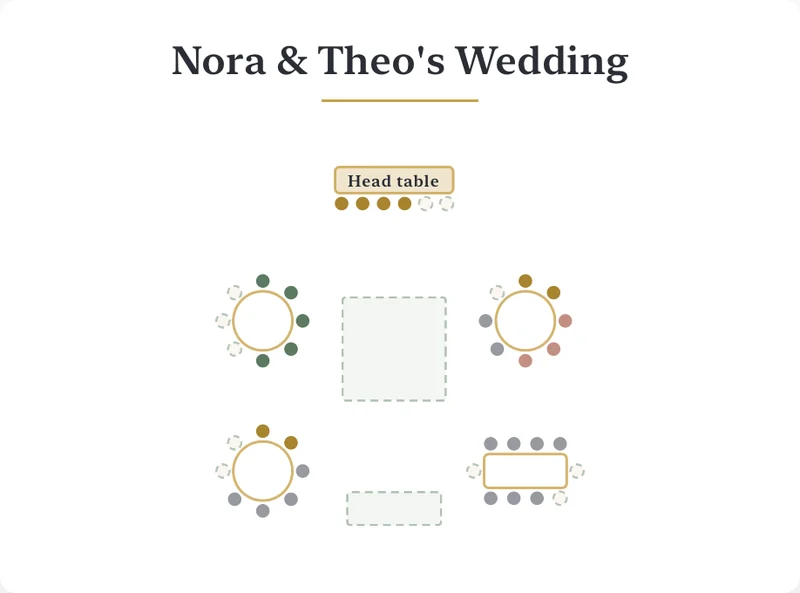
Not sure which you need? Read escort cards vs. place cards, or print a chart right away with the free seating chart templates.
Plan the whole chart on your phone.
 Download on theApp Store
Frequently asked questions
When should I start the wedding seating chart?
Start a draft once most RSVPs are in, usually four to six weeks before the wedding, and finalize it about one to two weeks before, when your caterer needs final numbers.
Do I need a seating chart for my wedding?
For a seated dinner, yes: it avoids a scramble for seats and lets the caterer serve plated meals. For a cocktail-style reception or a small, casual party, open seating can work, but reserve tables for close family.
Should I assign tables or exact seats?
Most couples assign tables and let guests pick their seat. Assigning exact seats with place cards helps when you serve a plated dinner with different entrées or want a formal dinner.
Where do I seat guests who don't know anyone?
Seat them with people of a similar age or with shared interests, next to someone outgoing who will make introductions, rather than at a table of leftovers.
How many guests should sit at each table?
8 at a 60-inch round and 10 at a 72-inch round for a comfortable plated dinner. The table calculator shows how many tables you need for your guest count.